

Table of Contents
- What Separates a $5 Tee From a Premium Graphic Tee
- The Best Fabric for Graphic Tees (and What Cheap Cotton Costs You)
- Screen Printing vs Direct to Garment Cost: How the Print Method Sets the Price
- How to Prevent Graphic T-Shirt Prints From Cracking: What Pays for Itself
- Artist Royalties, Limited Edition Drops, and the Real Cost of Original Design
- Ethical Manufacturing, Labor Costs, and Why Cheap Tees Hide the Difference
- Cost-Per-Wear: Why Premium Graphic Tees Are Often the Cheaper Option
- Frequently Asked Questions
Last Updated: September 20, 2026
What Separates a $5 Tee From a Premium Graphic Tee
A premium graphic tee costs more because every stage of its production, from the cotton fiber to the final print cure, adds measurable cost that a budget shirt skips. At Greatuncledad, we explain this gap to customers, and it almost always comes down to three things: fabric density, print method, and design licensing.
The short answer to why are premium graphic tees more expensive is that cheap shirts are built to hit a price point, while premium shirts are built to survive repeated washing without losing shape, color, or print integrity.
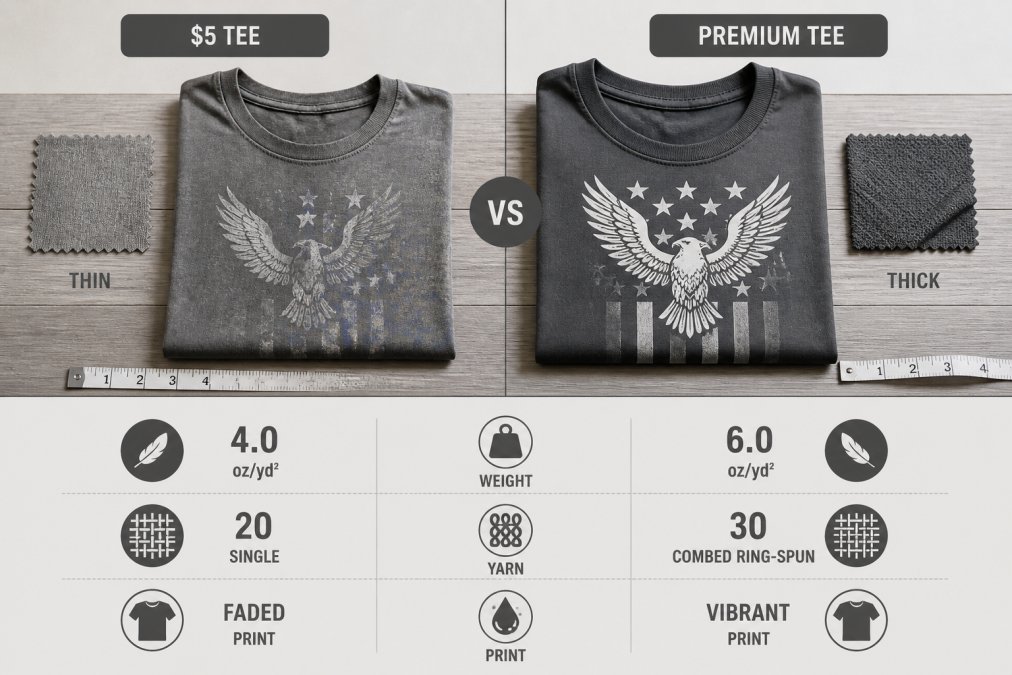
A $5 tee typically uses a thin, low-density knit that pills after a few washes. A premium graphic tee uses heavier yarn, tighter quality control, and a print process that bonds ink into the fabric rather than resting it on top.
Fabric weight and GSM: the first cost driver
GSM (grams per square meter) measures fabric density, and it is the single clearest predictor of how a shirt will feel and wear. Budget tees often land in the 130-150 GSM range, while heavyweight fabric for premium graphic tees generally starts around 180 GSM and climbs higher.
More cotton per square meter means more raw material cost, but it also means better opacity, less show-through, and a surface that holds a print cleanly. You can feel the difference in seconds.
Ring-spun vs. carded cotton: why softness costs more
Ring-spun cotton is made by continuously twisting and thinning the cotton fibers, which removes short fibers and aligns the longer ones into a smoother, stronger yarn. Carded cotton skips that extra refining step, leaving a rougher yarn with more protruding fiber ends.
That extra processing time is real money. It is also why ring-spun cotton feels noticeably softer against skin and resists pilling longer than carded cotton at the same weight.
The Best Fabric for Graphic Tees (and What Cheap Cotton Costs You)
The best fabric for graphic tees is a ring-spun or combed cotton in a mid-to-heavyweight range, because fiber length and fabric density determine how well a print bonds and how long the shirt keeps its shape.
Cheap cotton uses shorter fibers, which means more loose ends at the surface. Those loose ends are exactly where prints crack first, because the ink is anchored to fibers that are already shedding.
A common mistake shoppers make is judging a shirt only by how it feels in the store. Softness fades fast on low-quality cotton. What you want to check is the fabric density and the seam construction, because those determine whether the shirt still fits the same way after twenty washes.
Screen Printing vs Direct to Garment Cost: How the Print Method Sets the Price
Screen printing and direct-to-garment (DTG) printing carry different cost structures, and that difference shows up directly in the retail price of a graphic tee. The mechanism is simple: screen printing front-loads cost into setup, DTG front-loads cost into every unit, and the design's color count decides which one wins.
Screen printing requires a separate mesh screen for every color in the design, plus a registration pass to line the colors up. Setup costs are front-loaded, so screen printing becomes economical at higher quantities and expensive for small runs. The ink is pushed through the mesh and cured under heat, producing a thick, durable layer that holds up well over time. A one-color design needs one screen; a six-color design needs six screens, six registration steps, and six passes down the dryer. That is why a six-color print on a 24-unit run can cost more per shirt than the blank itself.
Direct-to-garment printing works like an industrial inkjet printer for fabric. There is no screen setup, so short runs and one-off designs stay affordable, but the per-unit cost is higher and the print sits closer to the surface of the fabric. DTG also typically requires a pre-treatment spray on cotton so the ink binds instead of bleeding, which adds a step, a chemical, and a drying pass that screen printing does not need.
| Method | Setup Cost | Best For | Print Durability |
|---|---|---|---|
| Screen printing | High per color | Bulk orders, 50+ units | Very high, thick ink layer |
| Direct-to-garment (DTG) | Low, no screens | Small runs, detailed art | Good, depends on fabric and cure |
| Heat transfer | Low | Photos, full-color art | Moderate, can peel at edges |
The cost curve is what matters. On a 500-unit run, screen setup is spread across hundreds of shirts and becomes a rounding error. On a 30-unit limited drop, that same setup is spread across 30 shirts, and the per-unit penalty is large.
How to Prevent Graphic T-Shirt Prints From Cracking: What Pays for Itself
Knowing how to prevent graphic t-shirt prints from cracking starts with buying the right base fabric, because ink adheres to fiber, and short-fiber cotton sheds. Wash the shirt inside out in cold water, tumble dry on low or hang dry, and never iron directly over the print.
Artist Royalties, Limited Edition Drops, and the Real Cost of Original Design
Original artwork is not free, and the price of a premium graphic tee often includes an artist royalty or a licensing fee that a mass-produced knockoff never pays.
Ethical Manufacturing, Labor Costs, and Why Cheap Tees Hide the Difference
Ethical manufacturing raises the cost of a shirt, and that increase is visible in the final price rather than hidden in the supply chain. But the more useful question is which specific costs, and how a buyer can tell a verified claim from a marketing one.
- GOTS (Global Organic Textile Standard) covers organic fiber content and requires social criteria and wastewater treatment at processing facilities. Certification runs across the entire supply chain, not just the farm, so every handler in the chain has to be audited.
- Fair Trade Certified adds a premium paid on top of the farmgate or factory price, and that premium goes into a worker-controlled community fund. It is a direct, measurable line item in the cost of goods.
- OEKO-TEX Standard 100 tests finished fabric for harmful substances. It is a product test, not a labor standard, and it is often confused with the two above.
- WRAP and BSCI/Sedex are social-compliance audit programs common in cut-and-sew factories. They verify working hours, wages, and safety, and they require re-audits on a cycle.
Cost-Per-Wear: Why Premium Graphic Tees Are Often the Cheaper Option
Cost-per-wear is the price of a garment divided by the number of times you actually wear it, and it reframes the entire comparison.
Frequently Asked Questions
Why are graphic tees so expensive now?
Several costs stack up at once. Heavier ring-spun cotton and combed cotton cost more per yard than basic carded cotton. Direct-to-garment and screen printing both add setup and ink costs. Add artist royalties, limited-edition runs, and fair wages, and a shirt that retails for $25 to $30 may only clear a few dollars of profit. The price reflects what went into making it, not just the design on the front.
What's the difference between a basic tee and a premium tee?
A basic tee usually uses lighter carded cotton, a thinner collar, and a print that fades or cracks within a dozen washes. A premium graphic tee uses heavier ring-spun or combed cotton, a seamless double-needle collar with high stitch density, and a tubular fit that resists torque. You can feel the difference in the first wash and see it after fifty.
Is a higher price always an indicator of better quality?
No. Some brands charge more for a logo or a trend, not for better fabric or construction. Check the spec sheet: GSM, fiber type, collar construction, and print method. A shirt with 100% ring-spun cotton, a double-needle collar, and a tear-away label at a mid-range price often beats a designer tee at twice the cost.
How does fabric weight affect the price of a t-shirt?
Heavier fabric uses more cotton per shirt, so it costs more to produce. A 4.5 oz tee uses roughly a third less cotton than a 6.5 oz heavyweight tee. Heavier fabric also holds its shape longer and takes a print better, which is why premium graphic tees tend to sit in the 5.5 to 6.5 oz range. You pay more upfront, but the shirt lasts longer.
The real challenge is not affording a premium tee. It is avoiding the false economy of replacing cheap ones every few months. Greatuncledad offers a curated collection of patriotic, faith-based, and humorous designs printed on quality ring-spun cotton, backed by a quality guarantee, fast shipping, and secure payments, with 24/7 email support if anything goes wrong. Sign up with Greatuncledad and start building a wardrobe that survives the wash cycle.
