

Table of Contents
- Why Most Graphic Tees Fall Apart After 10 Washes
- What Is GSM in T-Shirts and Why It Matters
- Screen Printing vs DTG Quality: Which Lasts Longer?
- Signs of Quality Graphic Tees: Construction Details to Check
- How to Prevent Graphic T-Shirt Prints from Cracking
- A Visual Inspection Checklist for Quality Graphic Tees
- Post-Wash Performance: The Real Test of Quality
- Conclusion: Buy Once, Wear for Years
- Frequently Asked Questions
Last Updated: September 7, 2026
Most graphic tees don't survive their first season. The print cracks, the collar stretches, and the fabric turns see-through after a few hot dryer cycles. Learning how to spot quality graphic tees before you hand over your money saves you from a shirt that looks worn out within a month. At Greatuncledad, we've built our collection around the principle that a graphic tee should look good wash after wash.
Fabric weight, print method, and construction details tell you everything about a shirt's lifespan before you ever wear it. Below, we'll show you how to examine each element and where most brands cut corners.
Why Most Graphic Tees Fall Apart After 10 Washes
The biggest mistake buyers make is assuming all cotton t-shirts are created equal. A cheap graphic tee typically uses lightweight fabric with a low GSM, meaning the fibers are loose and thin. When you wash it, the agitation breaks down those weak fibers, causing shrinkage, pilling, and a distorted fit.
The print fails for a different reason. Many budget brands use plastisol ink applied in thick layers that sit on top of the fabric rather than bonding with it. Each wash cycle flexes that layer, and eventually it cracks and peels away. A quality graphic tee uses printing methods that penetrate the fibers or properly cured ink that flexes with the fabric.
What Is GSM in T-Shirts and Why It Matters
GSM stands for grams per square meter, the industry standard for measuring fabric weight. A t-shirt at 150 GSM is light and breathable, while one at 200 GSM feels substantial and drapes better. For graphic tees, you want a heavier fabric because it provides a stable surface for the print and resists distortion.
Quality graphic tees typically fall in the 180 to 220 GSM range for heavyweight options. This weight feels substantial without being stiff or board-like. When you hold a quality tee up to the light, you shouldn't see through it easily, that opacity signals a tight, dense weave that holds its shape.
Screen Printing vs DTG Quality: Which Lasts Longer?
Screen printing and direct-to-garment (DTG) are the two dominant methods for putting graphics on t-shirts. Screen printing pushes ink through a mesh stencil onto the fabric, creating a layer on top. High-quality screen printing uses a proper cure process that binds the ink to the fibers and can last for years.
DTG printing works more like an inkjet printer, spraying ink directly into the fabric. The best DTG results feel soft to the touch because the ink absorbs into the fibers rather than sitting on top. The industry guidance on garment decoration methods explains that DTG quality depends heavily on pretreatment and the printer used.
| Print Method | Feel | Durability | Best For |
|---|---|---|---|
| Screen Printing | Slightly raised, plasticky | Excellent if properly cured | Bold, solid-color designs |
| DTG | Soft, integrated into fabric | Good, but fades faster on dark shirts | Detailed, photo-like graphics |
For darker shirts, DTG prints often require a white underbase layer that can crack sooner. High-quality brands use DTG on lighter fabrics or specialized techniques for dark garments to prevent premature wear.
The 30-Second Print Adhesion Stress Test
Before you buy, run this simple stress test right in the store. It takes thirty seconds and requires no tools.
The Flex Test: Gently pinch the fabric on either side of the printed area and pull your hands in opposite directions, stretching the shirt horizontally across the design. On a quality print, the ink should flex with the fabric without visible separation. On a poorly cured print, you'll see micro-cracks at the edges or fine lines within solid areas, the first sign of failure.
The Bend Test: Fold the shirt sharply through the center of the graphic, creasing the print. Run your thumbnail along the crease with light pressure. A properly cured screen print will show no mark. An undercured or overly thick print will show a visible white or light-colored line where the ink cracked, the exact mechanism behind the spiderweb cracking on cheap tees.
The Surface Feel Test: Run your palm across the printed surface. Quality screen prints should feel smooth and slightly raised but uniform. Rough, gritty, or tacky spots mean the ink wasn't cured evenly, those are weak points where cracking begins. For DTG prints, the surface should feel soft and integrated, almost like part of the fabric. If it feels raised or rubbery, it likely wasn't pretreated properly and will fade or crack prematurely.
The White Underbase Problem on Dark Shirts: If you're buying a light-colored design on a dark shirt, ask about the underbase. DTG printers lay down a white ink layer first to make colors pop. That white layer is the weakest link in the construction. High-quality brands use specialized white inks and curing processes that bond the underbase to the fabric. Budget brands often skip proper curing, so that white layer separates quickly, taking the design with it. When performing the flex test on a dark shirt, pay extra attention to the edges of white or light-colored areas, that's where underbase failure starts.
What This Means for Your Purchase Decision: A print that passes all three tests will survive 20 or more wash cycles without visible cracking. One that fails the flex or bend test will likely show damage within 5 to 10 washes. This stress test is the most reliable predictor of print longevity you can perform without owning the shirt for a month.
Signs of Quality Graphic Tees: Construction Details to Check
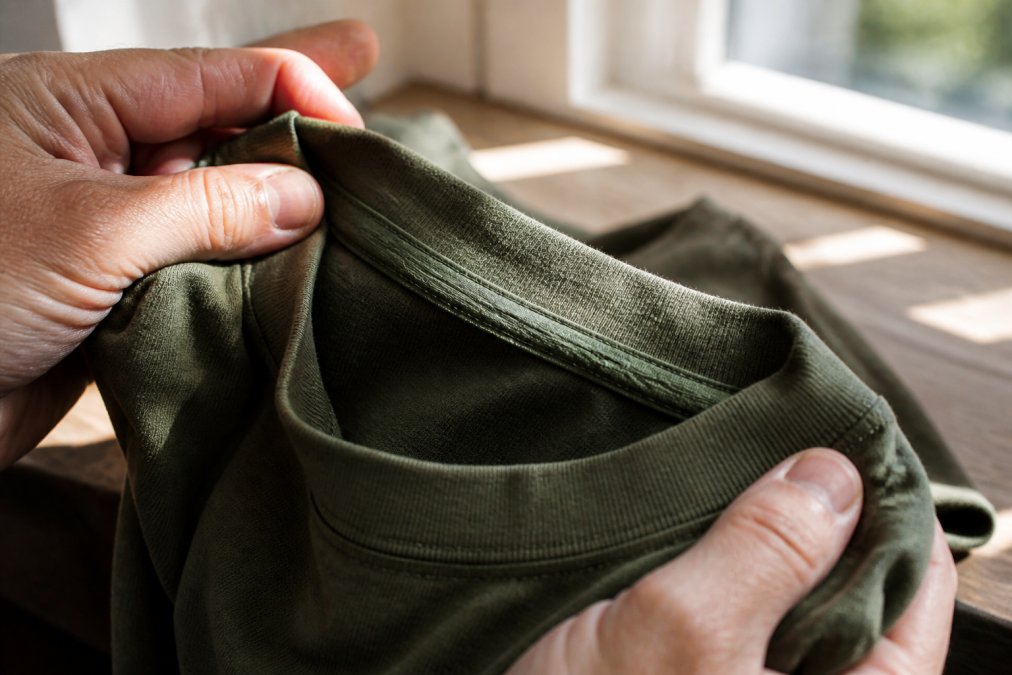
Quality graphic tees reveal themselves in the details most shoppers never examine. The inside of the shirt tells the real story, and a quick inspection takes less than a minute once you know what to look for.
Fabric Weight and Feel
The hand-feel of a shirt tells you more than any label. A quality heavyweight tee should feel smooth and dense, not rough or flimsy. Run your fingers across the fabric and check for a tight, even weave. Look for ring-spun cotton or combed cotton on the label, which indicates the fibers were processed to remove short strands and impurities, creating a softer and stronger yarn. The cotton fiber quality standards from the USDA explain that longer staple fibers produce stronger, more durable yarns that resist pilling and wear.
Stitching, Collars, and Seams
Turn the shirt inside out and examine the seams. A quality tee features double-needle stitching on the sleeves and bottom hem, creating two parallel rows that resist unraveling. The collar should have a seamless double-needle construction, knit as a single piece rather than cut and sewn, which prevents the dreaded bacon neck.
Look for taped shoulders and neck seams. A strip of fabric covering the shoulder seam adds structural integrity and prevents stretching when you pull the shirt over your head. This is a hallmark of quality graphic tees that budget brands skip to save pennies per shirt.
How to Prevent Graphic T-Shirt Prints from Cracking
Washing technique matters as much as print quality. Even the best screen print will fail early if you abuse it in the laundry. Turn the shirt inside out before every wash to protect the print from friction, and use cold water.
Heat is the enemy of both fabric and print. Hot water breaks down the ink binder, and high dryer heat accelerates cracking and shrinkage. Air dry your graphic tees whenever possible. If you must use a dryer, choose the lowest heat setting and remove the shirt while it's still slightly damp.
A Visual Inspection Checklist for Quality Graphic Tees
Before you buy, run through this quick checklist. It takes thirty seconds and separates quality graphic tees from overpriced disposables.
- Hold the fabric up to the light. Can you see through it easily? If yes, it's too thin.
- Feel the weight in your hand. A quality tee should have noticeable heft.
- Check the collar for seamless double-needle construction.
- Look inside for taped shoulders and neck seams.
- Examine the stitching on sleeves and hem for double rows.
- Check the print for proper adhesion. It shouldn't feel overly thick or plasticky.
- Pull gently on the fabric. A tight weave won't stretch excessively.
- Read the label for preshrunk cotton and ring-spun or combed fibers.
Post-Wash Performance: The Real Test of Quality
No inspection replaces the truth of the first few washes. A quality graphic tee should emerge from the laundry looking essentially the same as it went in. The fabric shouldn't shrink noticeably, the print shouldn't crack, and the collar shouldn't lose its shape. This is where the textile care labeling guidelines from the FTC come into play, since following the care instructions is part of protecting your investment.
What Actually Happens After 20 Washes
Here's the mechanism-level breakdown of what separates a shirt that survives 20 washes from one that doesn't.
The Collar: The most common failure point is the neckline. A cut-and-sew collar, where the band is a separate piece stitched onto the body, will stretch and deform within 10 to 15 washes because the seam creates a stress point. A seamless double-needle collar is knit as a single continuous tube, distributing stretch evenly. After 20 washes, a seamless collar should return to its original shape when laid flat; a cut-and-sew collar will show a wavy, distorted edge, especially at the shoulder seams. This is the "bacon neck" effect, the first visible sign of a shirt that won't last.
The Shoulder Seams: Taped shoulders, where a strip of fabric reinforces the seam where the sleeve meets the body, prevent stretching when you pull the shirt over your head. Without that tape, the seam stretches every time you put the shirt on and take it off. After 20 washes, an untaped seam will show visible puckering and may begin to separate; a taped seam should remain flat and smooth.
The Print: The flex and bend tests you performed in the store predict what happens in the wash. A properly cured screen print will show minor, uniform crazing (fine surface lines) after 20 washes, but the design will remain fully intact and legible. A poorly cured print will show large cracks that expose the fabric beneath, and pieces of ink may flake off. For DTG prints, the fade pattern is the tell: a quality print fades gradually and evenly, while a low-quality print fades in patches, especially in areas of heavy ink saturation, because the pretreatment wasn't applied evenly.
The Fabric: Shrinkage is the hidden killer of graphic tees. A shirt that shrinks 5% in the first wash will distort the print, causing it to pucker or crack. Quality brands use preshrunk cotton, pre-washed or mechanically treated to remove shrinkage before sewing. After 20 washes, a preshrunk shirt should show less than 2% total shrinkage; a non-preshrunk shirt can shrink 5-8%, enough to warp the print and ruin the fit.
The Loopwheeled Difference
At the premium end of the market, you'll encounter loopwheeled (or circular-knit) t-shirts. This method uses an antique circular knitting machine that produces fabric in a tube, with no side seams. The slow process creates a denser, more stable fabric that resists twisting and distortion, maintaining its drape and shape better than standard jersey knit after 20 washes. The trade-off is cost, typically $60 or more, and availability, since only a few mills worldwide still operate these machines. For most buyers, a high-quality preshrunk jersey knit with taped shoulders will perform nearly as well at half the price.
The 20-Wash Benchmark Test
To verify a shirt's quality claims, run this simple benchmark test at home. Wash the shirt 20 times using cold water and a gentle cycle, then air dry it each time. After the 20th wash, evaluate it against these benchmarks:
- Collar shape: Lay the shirt flat. The collar should be round and even, not wavy or stretched.
- Print integrity: Hold the shirt at arm's length. The design should be fully legible with no large cracks or missing ink.
- Fabric opacity: Hold the shirt up to a bright light. You should not be able to see through it easily.
- Seam condition: Check the shoulder seams and hem for puckering, loose threads, or separation.
- Overall fit: Compare the shirt to a similar style that hasn't been washed. The difference should be minimal.
A shirt that passes all five benchmarks is a quality graphic tee. One that fails on collar shape or print integrity will likely continue to degrade rapidly. This benchmark test is the gold standard for evaluating any t-shirt, and it's the same standard we apply to the Greatuncledad collection, including the 1900s Heavyweight Unisex Crewneck T-shirt, which uses preshrunk jersey knit cotton with double-needle stitching and taped shoulders specifically to pass this test. When you buy a shirt built this way, you're paying for longevity, not just a design.
Conclusion: Buy Once, Wear for Years
Knowing how to spot quality graphic tees comes down to checking fabric weight, print method, and construction details before you buy. A shirt with heavyweight cotton, a properly cured print, and reinforced seams will serve you for years, while a cheap alternative ends up as a rag or in the donation bin within months.
When you're ready to put this knowledge to work, browse the Greatuncledad collection of patriotic, faith-based, and humorous graphic tees. Every shirt is built on a heavyweight cotton base with the construction details outlined above, and our quality guarantee backs that promise. Sign up for updates and find a tee that reflects your values and is designed for durability.

Frequently Asked Questions
How can you tell if a graphic print will crack?
Check the print's flexibility and thickness before buying. Quality prints on quality graphic tees should flex with the fabric without forming visible surface cracks. Press on the design: if it feels stiff or plastic-like, it is likely to crack. Screen-printed designs with a soft hand-feel and DTG prints that absorb into the fabric are more durable. Also, review the care label for washing instructions, since improper washing causes most cracking.
Is 240 GSM good quality for a t-shirt?
Yes, 240 GSM is considered heavyweight and high quality. For context, standard tees are around 150-180 GSM, while premium options start near 200 GSM. A 240 GSM shirt offers more durability, better structure, and a substantial feel. This fabric weight holds its shape after washing and provides a better canvas for prints. Look for quality graphic tees in the 200-240 GSM range for a balance of comfort and longevity.
What printing method lasts the longest on t-shirts?
Screen printing generally lasts the longest when done correctly. It creates a thicker ink layer that bonds well with the fabric, especially on heavyweight cotton. However, a high-quality direct-to-garment (DTG) print can be nearly as durable and offers a softer feel. The print longevity also depends on the fabric weight; prints on heavier, preshrunk cotton tend to outlast those on lighter materials. Wash inside out in cold water to extend the life of either method.
What is the difference between a side-seam and tubular t-shirt?
A tubular t-shirt is knit as a single tube, so it has no side seams. This makes the shirt cheaper to produce, but it can twist after washing. A side-seam shirt has seams on both sides, which allows for a better fit and prevents twisting. Quality graphic tees often use side-seam construction because it keeps the print aligned and the shirt looking sharp after many washes. Check the interior for side seams to confirm better build quality.
Quality graphic tees aren't a mystery once you know what to examine. Skip the flimsy fabric and cracking prints by checking GSM, print method, and stitching before you buy. Greatuncledad builds every shirt with heavyweight preshrunk cotton, double-needle stitching, and taped shoulders for durability, and our quality guarantee and 24/7 email support have you covered if anything falls short. Get started with Greatuncledad and wear a shirt that lasts.
