

Table of Contents
- What Separates High Quality Screen Printing From Cheap Prints
- 1. Ink Opacity and Color Saturation That Survives Daylight
- 2. Crisp Edges, Tight Registration, and Clean Halftones
- 3. Ink Deposit and Texture: Soft-Hand Feel vs Thick and Rubbery
- Plastisol vs Water-Based Ink Quality: What the Difference Means for Your Tee
- 4. How to Prevent Graphic T-Shirt Prints From Cracking
- 5. The Screen Print Wash Test: Checking Durability and Wash-Fastness at Home
- 6. Substrate, Mesh Count, and Curing: Why the Base Garment Matters
- Frequently Asked Questions
Last Updated: September 12, 2026
What Separates High Quality Screen Printing From Cheap Prints
High quality screen printing presses ink through a fine mesh screen onto fabric, producing opaque color, sharp edges, and a soft feel that survives repeated washing. The signs show up in ink coverage, edge sharpness, print texture, and wash durability.
Cheap prints fail predictably: faded ink, bleeding edges, and cracking within a few washes. It comes down to ink type, mesh count, squeegee pressure, and cure.
The Five Quality Markers You Can Check in Seconds
| Marker | What Good Looks Like | What Cheap Looks Like |
|---|---|---|
| Ink opacity | Solid color, no fabric show-through | Faded, washed-out tone |
| Edge crispness | Sharp lines, clean halftones | Fuzzy, bleeding borders |
| Print texture | Soft-hand feel, ink sits in fabric | Thick, rubbery plastic layer |
| Wash-fastness | No cracking after repeated cycles | Cracks and peels early |
| Registration | Colors align tightly | Colors offset or doubled |
1. Ink Opacity and Color Saturation That Survives Daylight
The first sign of quality is opacity: ink sitting on the fabric as a solid, saturated color with no garment tone bleeding through. Hold the shirt to a window, a quality print stays rich and even, while a cheap one turns translucent and patchy.
Opacity comes from ink deposit and mesh count working together: a lower mesh count lays down more ink per pass. On dark garments, printers often lay a white under-base before the top color so the design reads true.
Plastisol ink holds bright, dense color on dark fabric with less effort than thinner inks. The trade-off is feel.
2. Crisp Edges, Tight Registration, and Clean Halftones
Sharp edges are the fastest tell. Run a fingernail along a printed line: a quality print has a clean, defined edge, while a cheap one shows a soft halo where ink bled past the screen.
Registration is the alignment of each color layer. In a multi-color design, every layer must land in exactly the right spot; poor registration gives text a doubled or ghosted look.
Halftones, the tiny dots that create gradients and shading, are the hardest element to print well. Clean halftones hold their dot shape. Sloppy ones smear into a gray blur. Screen tension and squeegee pressure control both, and they're the two variables most often rushed on high-volume runs.
3. Ink Deposit and Texture: Soft-Hand Feel vs Thick and Rubbery
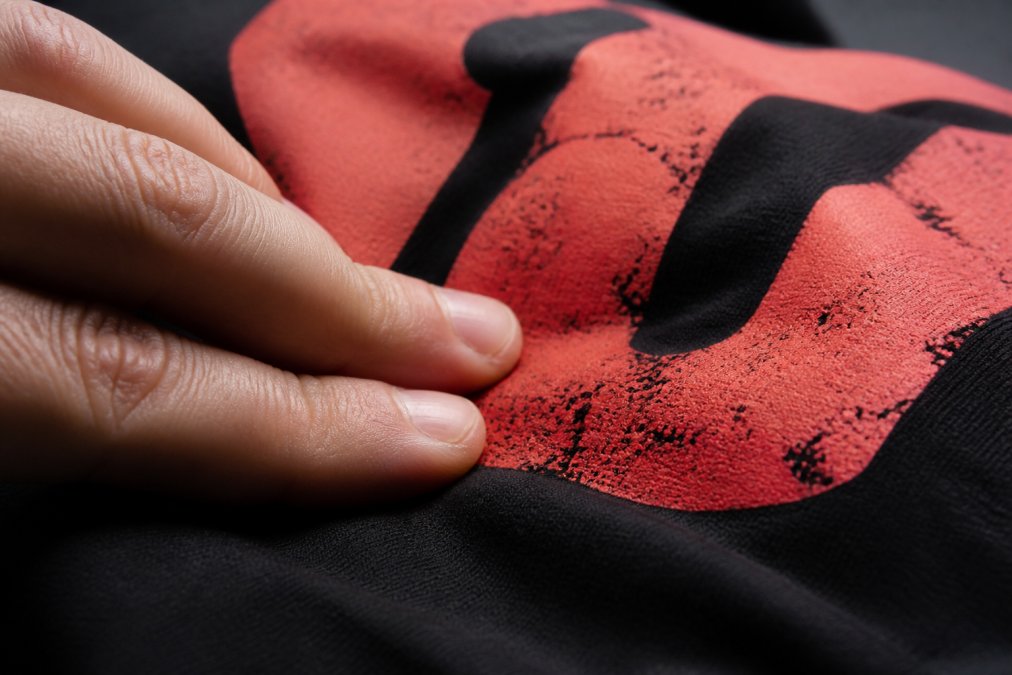
Ink deposit is the thickness of the printed layer, and it decides how the shirt feels against skin. A quality print has a soft-hand feel: the ink bonds into the fabric weave rather than sitting on top like a plastic sheet. Here is the touch test that separates a properly deposited print from a cheap one.
The Four-Point Touch Test
1. The palm press. Press your full palm onto the design for three seconds, then lift straight up. A quality print releases cleanly with no tacky drag; a cheap plastisol print grabs your skin slightly, like a rubber phone case. That tackiness is uncured plasticizer, the first sign the print never reached full cure temperature.
2. The thumbnail drag. Run your thumbnail across the printed area, perpendicular to the weave. On a good print, your nail glides and you feel the fabric texture underneath; on a thick, low-quality print, your nail catches on a ridge where the ink film sits above the garment.
3. The pinch and flex. Pinch a fold of the printed fabric and flex it back and forth five times. A properly cured print moves with the fabric and springs back; an undercured print develops a faint white stress line along the fold that stays visible after you release it.
4. The stretch check. Gently stretch the printed area about a quarter inch in each direction. Quality prints stretch with the knit and recover; cheap prints either resist (thick film, no elasticity) or show hairline fractures at the edges.
What Deposit Thickness Actually Means
Ink deposit is measured by the mesh count of the screen and the number of passes. A 110-mesh screen lays down a heavy, opaque deposit for bold white-on-black graphics; a 305-mesh screen lays down a thin, detail-friendly deposit for fine halftones. Most quality shops run 156 to 230 mesh for standard apparel graphics.
The trade-off is real: heavier deposit means more opacity but a stiffer hand and higher cracking risk; thinner deposit means a softer hand but less color punch on dark garments. Neither is automatically better, the question is whether the printer matched mesh count and ink type to the design and fabric.
Water-based inks deliver the softest hand because they soak into the fibers rather than coating them. Plastisol sits higher but holds brighter color. Discharge ink, which bleaches the garment dye rather than adding a layer, gives the softest hand of all on 100% cotton but won't work on synthetic blends.
Why 'Soft' Isn't Always the Goal
A common misconception is that the softest possible print is the highest quality print. A large back print on a heavyweight tee often benefits from a heavier deposit so color stays opaque after years of washing, while a fashion tee with a small chest logo wants the thinnest deposit. The quality marker isn't softness itself, it's whether the deposit matches the design's intent and the garment's weight.
Plastisol vs Water-Based Ink Quality: What the Difference Means for Your Tee
Plastisol ink is PVC-based, sits on top of the fabric, and must be cured at higher temperatures; water-based ink soaks into cotton fibers and cures at lower heat. Plastisol gives brighter color and sharper opacity on dark garments; water-based gives a softer, more vintage feel that fades gradually rather than cracking.
Here's what most buyers miss: the ink type matters less than whether it was cured correctly. An undercured plastisol print will crack and wash out no matter how good the ink was. A properly cured water-based print can outlast a poorly cured plastisol one every time.
| Factor | Plastisol Ink | Water-Based Ink |
|---|---|---|
| Feel | Sits on top, thicker | Soaks in, softest |
| Color on dark fabric | Bright, needs no under-base | Needs under-base for opacity |
| Durability | Excellent when cured | Excellent when cured |
| Look over time | Holds color, can crack | Fades softly, rarely cracks |
4. How to Prevent Graphic T-Shirt Prints From Cracking
The best way to prevent graphic t-shirt prints from cracking is to wash the shirt inside out in cold water and dry it on low heat or air-dry. Heat and agitation break down the ink film, so controlling both extends print life.
A few habits do most of the work:
- Turn the shirt inside out before washing so the print rubs against fabric, not the drum.
- Use cold water. Hot water softens and stresses the ink layer.
- Skip fabric softener, which leaves a residue that can dull the print surface.
- Air-dry when you can. If you use a dryer, choose the lowest heat setting.
- Avoid ironing directly over the design. If you must press it, iron the reverse side.
5. The Screen Print Wash Test: Checking Durability and Wash-Fastness at Home
A screen print wash test is a simple at-home method for judging wash-fastness: wash the garment inside out in cold water, dry it on low heat, and repeat three to five times while checking the print after each cycle. A quality print shows no cracking, peeling, or color loss. A weak one starts to fail by the second or third cycle.
Run the test like this:
- Wash the shirt alone or with similar colors, inside out, cold water, normal cycle.
- Dry on low heat or hang it to dry.
- After each cycle, stretch the printed area gently and look for hairline cracks.
- Check the edges of the design for lifting or peeling.
- Compare the color against the first day you wore it.
The Defect Gallery: What Each Failure Actually Looks Like
Most guides tell you to watch for cracking and peeling and stop there. But a print can fail in at least six distinct ways, each pointing to a different root cause on the press, knowing which defect you're looking at tells you whether the shop cut corners on ink, cure, or screen prep.
Pinholes. Tiny circular voids where the fabric shows through a solid area. Cause: dust, dried ink, or a clogged mesh opening. A few pinholes are common and often touched up by hand; a field of them means the screen wasn't properly cleaned or the ink was too thick to pass cleanly.
Fibrillation. A fuzzy, whitish haze over the print after washing, as if the shirt is growing hair through the ink. Cause: the ink deposit was too thin, or the printer skipped the under-base on a dark garment, letting cotton fibers poke through the film. Fibrillation is permanent.
Under-cure. The print feels slightly tacky weeks after purchase, and the first cracks appear along fold lines rather than at the edges of the design. Cause: the ink never reached full cure temperature. Plastisol needs to hit roughly 320°F throughout the ink film, not just on the surface. A shop that runs the conveyor too fast or checks temperature with an infrared gun instead of a probe will ship undercured prints without knowing it.
Over-cure / scorch. The print looks fine but the surrounding fabric has a yellow or brown tint, especially on white or light garments. Cause: too much heat or dwell time in the dryer. The ink is durable, but the garment is damaged, a quality failure even though the print itself will last.
Cracking. Hairline fractures that follow the direction of the fabric stretch, usually starting at the edges of the design and working inward. Cause: thick ink film combined with normal wear and washing. Thick deposits flex less than the cotton beneath them, so the ink fails first. Cracking is the most common defect and the one most often blamed on the customer when it's really a deposit-thickness problem.
Peeling. The print lifts off in sheets or flakes, usually starting at a corner or edge. Cause: poor ink adhesion, often from a garment that wasn't properly prepared, or a plastisol print on fabric with high synthetic content the ink can't bond to. Peeling is rare on properly printed 100% cotton and common on cheap prints applied to polyester blends.
Reading the Defect Like a Printer
Once you know the six failure modes, you can diagnose a print the way a shop foreman would: pinholes point to screen prep, fibrillation to deposit thickness, under-cure to the dryer, cracking to deposit thickness again, peeling to substrate compatibility, and scorch to heat settings.
That diagnostic skill separates a buyer who can spot a bad print from one who can explain why it's bad, and it tells you whether a shop's quality guarantee is worth anything. A printer who can name these defects and describe how they prevent each one actually monitors the press.
6. Substrate, Mesh Count, and Curing: Why the Base Garment Matters
The base garment is half the equation, and the part most buyers ignore. A quality print needs a substrate that holds ink and takes heat without warping. Ring-spun cotton, with its tighter, smoother yarn, gives ink a more even surface than a rough open-weave blank.
Mesh count controls how much ink passes through the screen. Lower mesh lays down more ink for bold, opaque shapes. Higher mesh produces finer detail and thinner deposits. A printer who matches mesh count to the design gets crisp edges and consistent coverage across every shirt in the run.
Curing decides long-term durability. Ink must reach a specific temperature for a specific dwell time in the conveyor dryer or heat tunnel: under cure and the print washes out, over cure and the fabric scorches. Consistency comes down to whether the shop monitors cure temperature on every run, not just the first one.
This is where a quality guarantee actually means something. Greatuncledad backs its graphic tees with a quality guarantee, fast shipping, and secure payments, and our Patriotic Faith USA 250th Anniversary Commemorative T-Shirt is printed on ring-spun cotton for exactly this reason: the smoother substrate holds a cleaner, more durable print.

For buyers who care about where their clothes come from, it's worth checking whether a printer uses eco-friendly ink options and holds recognized textile sustainability certifications. Water-based and discharge inks avoid the PVC base in plastisol, and third-party certification programs verify claims that would otherwise be marketing copy. As the FTC's guidance on environmental marketing claims makes clear, "eco-friendly" claims need real substantiation behind them.
Cheap prints announce themselves fast: faded color, fuzzy edges, a rubbery surface, and cracks by the third wash. Quality prints stay opaque, hold sharp edges, feel soft against skin, and survive the wash test.
Greatuncledad prints on ring-spun cotton and heavyweight blanks, covers every order with a quality guarantee, and offers 24/7 email support if a print ever falls short. Browse the Eagle and Cross Patriotic Christian T-Shirt or the Funny Sarcastic Vintage Born Pre-2000 Graphic T-Shirt to see the difference a properly cured, properly deposited print makes.


Sign Up for the Greatuncledad newsletter to get first access to new designs and restocks.
Frequently Asked Questions
How can you tell if a screen print is high quality?
Check four things: ink opacity (hold it to light, no shirt color should bleed through), edge crispness (lines should be sharp, not fuzzy), feel (a quality print bends with the fabric rather than sitting on top like a rubber patch), and stretch (gently pull the print, it should flex without cracking). Registration matters too, so colors that touch should line up exactly with no gaps or overlaps.
Does high-quality screen printing crack easily?
No. Cracking comes from too much ink deposit, under-curing, or a print that cannot flex with the fabric. A properly cured plastisol or water-based print on a quality substrate stretches with the garment and holds up through dozens of wash cycles. If a print cracks within a few washes, the ink was likely under-cured, laid on too thick, or printed on a low-quality blank.
What is the difference between plastisol and water-based screen printing?
Plastisol ink sits on top of the fabric, giving bold opacity and vibrant colors with a slightly raised feel. Water-based ink soaks into the cotton fibers, producing a soft-hand feel where you barely feel the print. Plastisol is more forgiving for beginners and dark garments, while water-based ink gives a vintage, breathable look. Both hold up well when cured properly.
How does ink opacity affect the quality of a graphic tee?
Ink opacity determines whether the shirt color shows through the design. High-opacity prints look solid and saturated, especially on dark garments where an under-base is often needed. Low-opacity prints look washed out or muddy, and colors shift after a few washes. A quick test: hold the shirt up to a window. If you can see the fabric weave through the ink, opacity is too low.
Why does some screen printing feel thick and rubbery?
Thick, rubbery prints usually come from a heavy ink deposit, often the result of too many passes with the squeegee or a low mesh count screen. Some printers add a thick under-base on dark shirts, which adds bulk. A quality print uses the minimum ink needed for full opacity, so it feels soft and flexible rather than like a plastic decal stuck to your chest.
How can you prevent graphic t-shirt prints from cracking?
Wash the shirt inside out in cold water on a gentle cycle, and skip the dryer or use low heat. High heat is the main cause of cracking because it makes the ink brittle. Avoid ironing directly on the print, and never bleach or dry clean a screen-printed tee. Turning the shirt inside out protects the print from rubbing against other garments during the wash cycle.
What does a screen print wash test tell you about durability?
A wash test reveals how well the ink bonded to the fabric and whether the cure was complete. Wash the shirt inside out in cold water, then air dry. A quality print shows no cracking, peeling, or color fade after 10 to 20 cycles. If the print starts flaking or the colors dull after two or three washes, the ink was under-cured or the deposit was too thick.
