

Table of Contents
- Why Originality Matters in Graphic Design
- How to Check for Design Plagiarism
- Evaluating Visual Hierarchy and Negative Space
- Typography and Color Palette Analysis
- Identifying High-Quality Screen Printing
- AI-Generated vs. Human Design: What to Look For
- Funny Graphic Tees for Men 2026: Spotting Unique Designs
- Legal and Copyright Verification
- Frequently Asked Questions
Last Updated: September 16, 2026
Why Originality Matters in Graphic Design
Originality in graphic design means a design stems from independent creative work rather than imitation. It protects buyer and creator alike, and it is why two similar shirts can feel completely different once worn.
How to Check for Design Plagiarism
Design plagiarism is the use of another creator's artwork, layout, or concept without permission or meaningful change. Spotting it takes a few repeatable checks, usually under ten minutes per design.
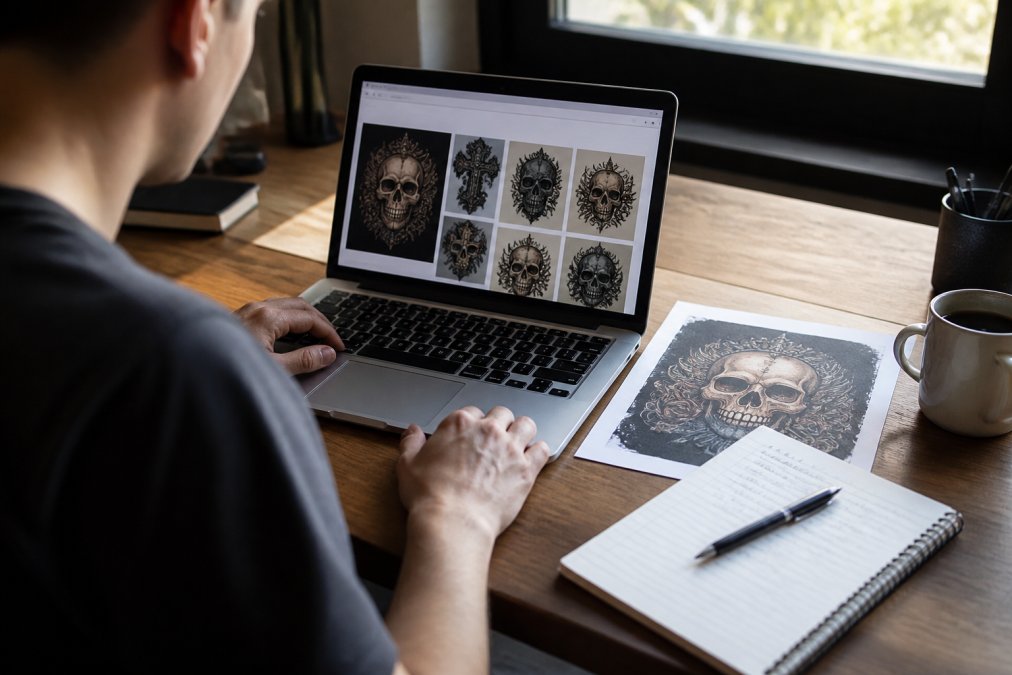
Start with these steps:
- Screenshot the design at the highest resolution you can and crop out text, price tags, or model shots so you are searching the image itself.
- Save the crop as a PNG or JPG under 20 MB, most reverse image tools reject larger files or downscale them in ways that hurt matching.
- Run a reverse image search on the cropped file.
- Scan for near-identical matches, not just exact ones. A flipped, recolored, or cropped version is still a match.
- Check the seller's other listings for the same artwork with swapped colors or a new slogan.
- Note the earliest date the original appeared. A design that predates the listing is a strong signal.
Reverse Image Search Techniques
Reverse image search means uploading an image to a search engine to find where else it appears online, the fastest way to catch a lifted design before you buy.
- Crop to the central figure. Partial matches often surface the source a full-image search misses, because the rest of the design is noise to the algorithm.
- Search the flipped version. Mirror the image horizontally, then search again. Sellers who lift artwork often flip it to dodge detection.
- Search the background separately. A pattern or texture lifted from a stock library will match even when the foreground illustration is original.
- Try a text-only search of the slogan. Put any phrase in quotes in a search engine; slogans are often lifted alongside the art.
-
Check the image's metadata. A file named
shutterstock_1234567.jpgor one with a stock agency in the metadata is a giveaway.
Logo Originality Verification
Logo originality verification means confirming a mark on a shirt is not a lightly disguised version of a known brand. This is where casual shoppers get burned most: a near-miss logo can look like a parody to a buyer and like infringement to a brand's legal team.
Watch for these red flags:
- A familiar silhouette with one letter or shape changed
- A color scheme lifted wholesale from a major brand
- Fonts that mimic a trademarked wordmark too closely
- Slogans that are near-misses of registered taglines
- A mascot or character that reads as a knockoff of a well-known one
Plagiarism Detection Workflow
For a repeatable process rather than a one-off check, run designs through a short workflow. It takes about ten minutes per design and catches most lifted artwork.
- Capture. Screenshot the listing image at full resolution and save the original file.
- Isolate. Crop to the artwork only, removing text, mockups, and background.
- Search. Run the crop through Google Lens and TinEye. Record the top five results for each.
- Compare. Open any near-match in a side-by-side viewer. Look at line weight, proportions, and distinctive details, a lifted design usually keeps the distinctive detail and changes everything around it.
- Verify the date. If the match predates the listing, the listing is the copy.
- Check the seller. A single lifted design can be an accident; a pattern of them is a business model.
- Document. Save screenshots of the match, the URL, and the date, the evidence you will need if you file a takedown.
Evaluating Visual Hierarchy and Negative Space
Visual hierarchy is the arrangement of design elements so the eye travels in a deliberate order; negative space is the empty area that gives those elements room to breathe. Together they separate a composed design from an assembled one.
Typography and Color Palette Analysis
Typography and color palette analysis is the study of how a design's lettering and colors work together to create a mood. Inconsistent type or a clashing palette is one of the clearest signs of a rushed, unoriginal design.
Look for these signals:
| Signal | What It Suggests |
|---|---|
| Two or more unrelated fonts | Assembled from templates |
| Colors that fight each other | No deliberate palette |
| Text touching the artwork edge | Poor composition |
| Lettering stretched or squashed | Font used without care |
| One dominant, intentional hue | Considered design |
Squint at the design from a few feet away. If the type and artwork blur into an even, balanced shape, the composition is sound. If it looks patchy, the hierarchy is off.
Identifying High-Quality Screen Printing
High-quality screen printing presses ink through a mesh screen onto fabric, producing sharp edges and colors that sit on top of the shirt rather than soaking in. Print quality tells you whether the maker cared about the final product or just the listing photo.
Common Print Quality Mistakes
Several print failures show up again and again, most tracing back to cut corners on the artwork or the press.
- Too much detail. Fine lines and tiny text clog a screen and blur on fabric.
- Thin outlines. Hairline strokes disappear after a few washes.
- Low-contrast colors. Similar tones blend together and the design turns to mud.
- Overloaded ink. Heavy layering cracks and peels over time.
AI-Generated vs. Human Design: What to Look For
AI-generated design is artwork produced by a machine-learning model rather than a human illustrator, and it has recognizable tells. None is proof alone, but together they point in one direction.
Watch for:
- Hands with too many or too few fingers
- Text that looks like letters but spells nothing
- Symmetry that is almost, but not quite, perfect
- Backgrounds that dissolve into nonsense at the edges
- A polished overall look with no clear concept underneath
Funny Graphic Tees for Men 2026: Spotting Unique Designs
Shopping for funny graphic tees for men in 2026 comes down to one filter: does the joke belong to this shirt, or has it been printed a thousand times already? The best humorous designs are specific, and specificity is hard to copy.
Here is what to check before you buy:
- Does the humor rely on a current meme that will feel dated in a month?
- Is the punchline original, or a tired phrase with a new font?
- Does the artwork support the joke, or just sit next to it?
- Would you still wear it in a year?
Legal and Copyright Verification
Copyright verification means confirming a design is not protected by someone else's copyright or trademark before you buy or sell it. In the United States, copyright protects original creative work automatically from the moment it is fixed in a tangible form, no registration notice, © symbol, or filing required. That is the fact most shoppers get wrong.
What Copyright Covers, and What It Does Not
Copyright protects the specific expression of an idea, the particular illustration, the exact arrangement of elements, the wording of a slogan, not the idea itself. A design of a bald eagle is not protected; a specific drawing of one is. That is why two shops can both sell eagle shirts without infringing, and why one can still infringe by copying the other's exact eagle.
- Search the phrase or slogan in the U.S. Copyright Office records for registrations. Registration is not required for protection, but it is required before a copyright owner can sue for infringement in federal court, so a registration is a strong signal the owner is serious.
- Cross-check brand marks in the USPTO trademark database.
- Look for a visible artist credit or licensing note on the listing. A shop that credits its artists is usually a shop that licenses its artwork.
- Be wary of designs that lean on a celebrity, team, or franchise without any license shown. Public figures have rights of publicity, and franchises have trademark and copyright protection that a small shop almost never has a license for.
How Long Copyright Lasts
For works created today, copyright lasts the life of the author plus 70 years. For works made for hire, anonymous, and pseudonymous works, it lasts 95 years from publication or 120 years from creation, whichever is shorter. A design that looks vintage may still be protected, a 1960s cartoon character is almost certainly still under copyright, even if the original artist has died.
Fair Use Is Narrower Than Most People Think
Fair use is a legal doctrine allowing limited use of copyrighted material without permission for purposes like criticism, commentary, news reporting, teaching, and parody. It is decided case by case using four factors: the purpose and character of the use, the nature of the work, the amount used, and the effect on the market for the original.
Reading a Trademark Record
A USPTO record has several fields, but two matter most:
- Goods and services. A mark registered for apparel (Class 25) is directly relevant to a t-shirt design. A mark in a different class may not block you, but it can still create confusion if the brands are similar.
- Status. A "live" mark is actively protected; a "dead" or "abandoned" mark is no longer enforced, though the underlying copyright in any artwork may still exist.
Originality is verifiable. Reverse image search, a trademark lookup, a copyright records check, and a close look at the print will tell you more about a design than any product photo ever will. When in doubt, assume the design is protected and walk away.
Frequently Asked Questions
How can you tell if a graphic design is stolen or original?
Run a reverse image search using Google Lens or TinEye to see if the design appears elsewhere. Check for subtle alterations like color shifts or flipped elements. Look for a consistent artistic style across the designer's portfolio. Verify if the design is registered with the U.S. Copyright Office. If you find exact matches on multiple sites without attribution, it's likely stolen. Always ask the seller for proof of ownership or licensing.
What makes a graphic design stand out from mass-produced art?
Unique designs often have a distinct concept, custom typography, and thoughtful composition. They avoid generic clip art or common templates. High-quality prints use soft, breathable inks that don't crack. Limited edition runs or original artwork also signal uniqueness. Check for a consistent aesthetic across the brand's collection. If the design feels personal and tells a story, it's likely original.
How do you identify high-quality graphic prints on clothing?
Look for screen printing with a soft hand feel and vibrant colors that don't fade after washing. The ink should be evenly applied without cracks or peeling. Check the fabric weight; heavier cotton holds prints better. Inspect the edges of the design for sharpness. A quality print will stretch with the fabric without breaking. Ask about the printing method and ink type used.
Why is originality important in graphic design?
Original designs protect your brand from legal issues like copyright infringement. They also create a unique identity that customers remember. Mass-produced or stolen designs can damage your reputation and lead to lawsuits. In the U.S., copyright law protects original works, giving creators exclusive rights. Supporting original art fosters a fair marketplace and encourages creativity. Always verify the source of any design you purchase.
Spotting a genuinely original design takes practice, but the payoff is a shirt you actually want to wear and a maker you can trust. Greatuncledad builds its collection around patriotic, faith-based, and humorous designs, each backed by a quality guarantee, fast shipping, and secure payments, with 24/7 email support if you have questions before you order. Sign up with Greatuncledad and find graphic tees that stand out for the right reasons.
