

Quick Summary
The best eco-friendly inks for custom graphic shirts are water-based, plant-based and hydro-soy formulations, because they replace petroleum-derived plastisol with water or plant oils. They feel softer on the skin, but their real footprint also depends on proper curing, screen cleanup and the fabric chosen.
- Water-based inks release far fewer volatile organic compounds than solvent-based alternatives.
- Water-based prints soak into the fibers, so the design barely changes the shirt's hand.
- Dark shirts usually need an underbase or discharge printing to make water-based ink opaque.
- Discharge printing works only on dischargeable 100% cotton, not polyester or blends.
- Under-cured water-based prints can crack, fade or wash out faster than buyers expect.
Table of Contents
- Why Ink Choice Matters for Eco-Friendly Custom Shirts
- What Makes Printing Ink Eco-Friendly
- Water-Based Ink for T-Shirt Printing: How It Works and Where It Falls Short
- Vegetable-Based Inks for Printing: Soy, Hydro-Soy and Plant Ingredients
- Eco-Friendly Screen Printing Ink Compared: Water-Based, Plant-Based and Plastisol
- Dark Shirts, Fabrics and Cost: Practical Trade-Offs When Choosing Ink
- Choosing Your Eco-Friendly Shirt: Greatuncledad Options to Start With
- Frequently Asked Questions
Why Ink Choice Matters for Eco-Friendly Custom Shirts
Last Updated: November 6, 2026
Most people never think about the ink on a graphic tee until it cracks after three washes. Greatuncledad sells printed shirts for patriotic, faith-based and humorous designs, and the ink behind each one shapes how it feels, how long it lasts and what it does to the environment. Choosing eco-friendly inks for custom graphic shirts is a durability and comfort question as much as a sustainability one.
Ink sits on the fabric, so it touches the skin. A heavy plastisol print leaves a stiff patch, while a water-based print soaks into the fibers and feels nearly invisible.
Conscious buyers often ask whether an eco-friendly ink is simply a marketing label. The answer depends on the ingredients, the solvents used and how the print is cured. This guide covers the main ink types, where each falls short, and how to judge a print before you buy.
What Makes Printing Ink Eco-Friendly
An ink is eco-friendly when it reduces harmful inputs across its life: fewer petroleum-derived ingredients, fewer volatile solvents released into the air, and cleaner wastewater after screen cleanup.
Several factors matter in practice:
- Base material: Water, plant oils or soy derivatives generally replace fossil-fuel plastics.
- Solvent load: Water-based inks release far fewer volatile organic compounds than solvent-based alternatives.
- Chemical additives: Some plasticizers and heavy-metal pigments raise health and disposal concerns.
- Curing and cleanup: Lower-temperature curing and water-based screen washing reduce energy use and wastewater pollution.
Water-Based Ink for T-Shirt Printing: How It Works and Where It Falls Short
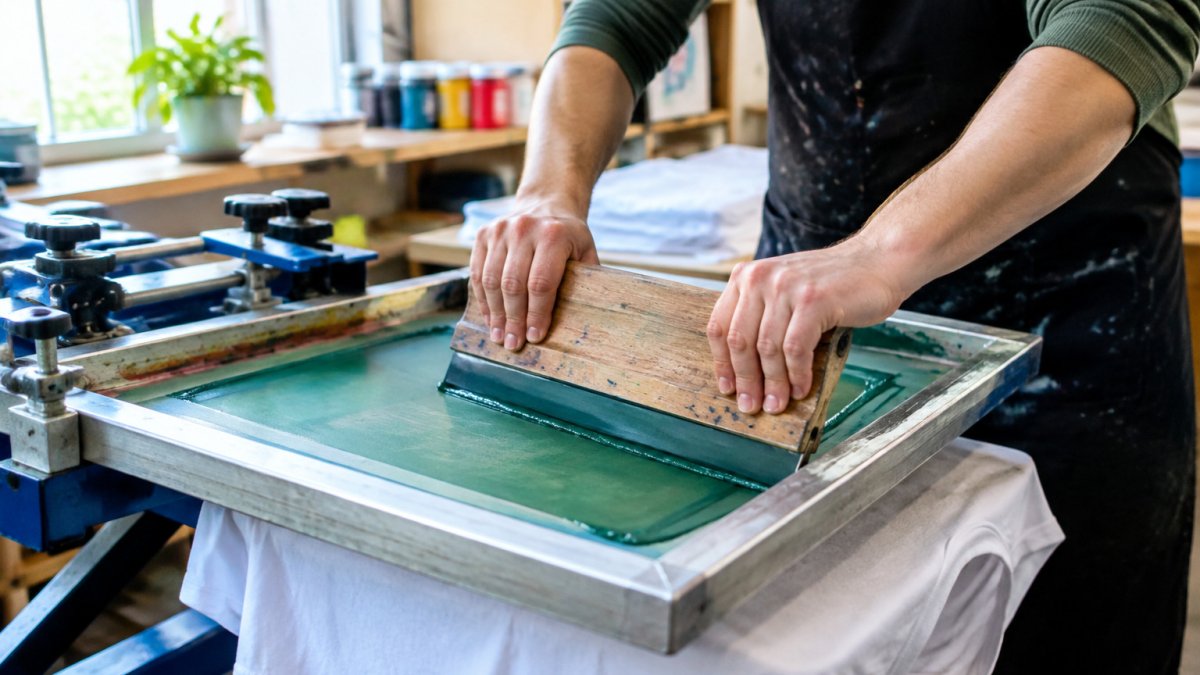
Water-based ink uses water as its main carrier, with pigment and a binder that fixes to the fabric as it dries.
The main advantage is feel. Water-based prints soak into the cotton, so the design barely changes the hand of the shirt.
Water-based ink also works best on light garments. A guide to signs of high quality screen printing on graphic tees covers what to look for when judging a finished print.
Vegetable-Based Inks for Printing: Soy, Hydro-Soy and Plant Ingredients
Vegetable-based inks replace some or all of the petroleum-derived binder with plant oils. Soy-based and hydro-soy formulations are the most common versions.
Plant-based inks are generally chosen by buyers who want a renewable ingredient story, though plant ingredients can vary from batch to batch.
For a shopper, the practical question is what the ink is actually made of. A plant-based claim should name the ingredients, not just use a green label.
Eco-Friendly Screen Printing Ink Compared: Water-Based, Plant-Based and Plastisol
Most buyers encounter three ink families, but a practical comparison has to go beyond base material. The table below adds discharge and hybrid/plastisol-water blends and scores each on ingredients, hand feel, opacity on dark garments, fabric compatibility, durability, cleanup and lifecycle trade-offs.
| Ink Type | Base Material | Hand Feel | Dark Shirt Opacity | Fabric Compatibility | Durability and Wash | Cleanup and Lifecycle | Main Drawback |
|---|---|---|---|---|---|---|---|
| Water-based | Water, pigment, binder | Soft, breathable, sinks into fibers | Low without underbase; moderate with underbase | Best on 100% cotton and cotton-rich blends | Good when fully cured; can fade if under-cured | Water-based screen wash; lower VOC release; curing energy varies by shop | Needs careful curing and often an underbase on darks |
| Discharge | Water-based carrier with discharge agent | Very soft, almost no hand | High on dischargeable cotton; no underbase needed | 100% cotton only; not reliable on polyester or blends | Good on cotton; color can shift over time | Strong odor during printing; requires ventilation; wastewater needs care | Limited to cotton; process control matters |
| Plant-based / hydro-soy | Plant oils, water, pigment | Soft to moderate | Moderate; extra passes may be needed | Cotton and some blends | Comparable to water-based when cured well | Renewable inputs; batch variation; cleanup similar to water-based | Color consistency and opacity can vary by batch |
| Hybrid / plastisol-water blend | Water-based carrier with some PVC or plasticizer | Moderate; softer than plastisol | High; easier on darks than pure water-based | Broad, including blends | Strong; resists cracking | Still contains some petroleum-derived content | Not a fully PVC-free choice |
| Plastisol | PVC and plasticizers | Thick, stiffer, sits on fabric | Strongest; minimal underbase needed | Works on most fabrics, including polyester | Very durable; resists cracking | Petroleum-derived; plasticizer and disposal concerns | Heavier feel and least attractive environmental profile |
A few practical reads from that table. Water-based and discharge are the softest options, but discharge only works on dischargeable cotton, while water-based can print on blends with the right binder.
Ask which ink family a print uses before comparing quotes, since "eco-friendly ink" is not a standardized term.
How to verify an eco-friendly ink claim
Vague terms such as "green," "non-toxic" and "eco" are not regulated marketing terms for apparel ink. A substantiated claim usually comes with an ingredient disclosure or safety data sheet (SDS) from the ink manufacturer, a certification for the printed product or facility, or a clear statement of the ink family and carrier. Common certifications to ask about include OEKO-TEX Standard 100 for the finished article and facility-level programs such as bluesign or GOTS.
A practical request list for any printer:
- The ink manufacturer and product name, not just the ink family.
- The safety data sheet or ingredient disclosure for that product.
- Whether an underbase or discharge agent is used, and what it contains.
- How screens are cleaned and how wastewater is handled.
Lifecycle trade-offs the table does not show
Ink ingredients are only one part of the footprint. Curing energy, screen-cleaning chemicals, wastewater, packaging and production waste often matter as much as the carrier.
Patriotic Faith USA 250th Anniversary Commemorative T-Shirt →
The lowest-impact print usually comes from a shop that combines a water-based or plant-based ink with low-temperature curing, water-based screen reclaim, and a cotton garment that will be worn for years. The ink choice matters, but it is not the whole story.
Dark Shirts, Fabrics and Cost: Practical Trade-Offs When Choosing Ink
Dark garments are where ink choice gets tested. On a white or light shirt, a water-based print can sit directly on the fabric and look crisp with a single pass.
There are three common ways shops solve the dark-shirt problem:
- Underbase plus water-based color: The most common approach. The print stays softer than plastisol but is thicker than a single-pass water-based print on a light shirt.
- Discharge printing: A discharge agent in the ink removes dye from the cotton so the color can sit directly on the fabric. On dischargeable 100% cotton, this gives a very soft print with no underbase. It does not work reliably on polyester or blends, and it requires tight process control.
- Plastisol or hybrid: The easiest route to bold opacity on darks and blends, at the cost of a heavier hand and, for plastisol, PVC content.
Fabric content changes the answer. Cotton-rich fabrics, 100% ring-spun cotton, 90% cotton and 10% polyester, 65% cotton and 35% polyester, generally take water-based and discharge inks more readily. High-polyester heather blends, such as a 35% cotton and 65% polyester shirt, may need a different ink chemistry or a lower curing temperature to avoid dye migration, where the garment's dye bleeds into the print during curing.
Curing and wash performance
Curing decides whether a print survives the wash. Water-based inks need to reach a specific temperature for a specific time so the binder crosslinks to the fiber. To reduce that risk, see how to prevent graphic T-shirt prints from cracking.
A practical wash test for a sample shirt: wash it inside out in cold or warm water with similar colors, tumble dry low, and inspect after the first, fifth and tenth wash.
What actually drives cost
Eco-friendly ink can carry a higher per-print cost, though ink price is often only one part of the total. The cost of a printed shirt is driven mainly by order size, setup, garment choice and print complexity:
- Order size: Screen printing has setup costs per color and per screen. Small runs spread that setup over fewer shirts, so the per-shirt price is higher regardless of ink type.
- Setup and screens: Each color adds a screen and a setup charge. A one-color water-based print on a light shirt is the cheapest configuration; a multi-color print with an underbase on a dark shirt adds screens and passes.
- Garment choice: A 100% ring-spun cotton shirt costs more than a basic cotton tee, and a heavyweight shirt costs more than a standard one. The garment often moves the price more than the ink.
- Print complexity: Underbases, discharge agents and specialty finishes add labor and time.
A realistic way to compare quotes is to ask for the same design, garment and quantity in two ink families, then compare the per-shirt price and the minimum.
Matching ink to garment and use
- Light 100% cotton shirts: Water-based or plant-based inks give the best feel and color with the fewest passes.
- Dark 100% cotton shirts: Discharge or water-based with an underbase for softness; plastisol or hybrid if maximum opacity matters more than hand feel.
- Cotton-poly blends: Confirm the exact blend and ask about dye migration; a hybrid or plastisol may be the safer choice on high-polyester heathers.
- High-polyester performance fabrics: Specialty low-cure inks or plastisol are common; water-based alone may not adhere or cure reliably.
- Long-wear or heavy-use shirts: Prioritize cure quality and wash testing over ink family.
The practical takeaway: choose the garment first, then ask the printer which ink family fits that fabric and the desired hand feel, and finally compare quotes at the same quantity and design.
Choosing Your Eco-Friendly Shirt: Greatuncledad Options to Start With
If you want a shirt that prioritizes print quality and a softer hand, the Patriotic Faith USA 250th Anniversary Commemorative T-Shirt is a useful starting point.
For a heavier, longer-wearing base, the 1900s Heavyweight Unisex Crewneck T-shirt from Gildan uses 100% preshrunk cotton in solid colors, with double-needle sleeve and bottom hems and taped neck and shoulders.

Shoppers who value a faith-based message can look at the God Is Still Writing Your Story Christian T-Shirt, priced at $21.58, or the Faith-Inspired Christian Graphic T-Shirt at $29.98.

Whichever design you choose, check the fabrication details and care instructions.
A practical approach is to pick a light-colored, cotton-rich shirt and ask the printer how the ink is cured before you order.
Frequently Asked Questions
What are some eco-friendly inks for printing?
Water-based inks and vegetable-based inks, including soy and hydro-soy formulations, are the most common eco-friendlier options for screen printing on shirts. Water-based inks use water as the main carrier instead of petroleum solvents, and plant-based inks replace part of the petroleum-derived binder with renewable ingredients. Neither is automatically better in every case: softness, opacity on dark garments and wash durability vary by formulation, so compare the printer's specifications and ask which certifications or ingredient disclosures apply to the exact ink being used.
Is water-based ink more eco-friendly than plastisol?
In most comparisons, yes. Plastisol is a PVC-based ink that needs high curing temperatures and relies on petroleum-based plasticizers, while water-based inks use water as the solvent and typically cure at lower temperatures. The trade-off is that water-based inks can feel different on the fabric, may need more passes on dark shirts, and cost more per print in some setups. Ask your printer for ingredient information rather than relying on the label alone.
Are vegetable-based inks suitable for printing on shirts?
Vegetable-based inks can be suitable for shirts, particularly for designs with soft colors and simple artwork. They tend to produce a softer hand than heavy plastisol prints. Performance depends on the fabric, the garment color and the curing process, so test a sample on the same blank shirt style before ordering a large run, and check how the print holds up after several washes.
What is the most sustainable ink for custom graphic shirts?
There is no single answer, because sustainability covers ingredients, production, water use, wastewater and how long the shirt lasts. Water-based and plant-derived inks reduce reliance on petroleum inputs and avoid PVC, which makes them strong choices for shoppers who prioritize lower chemical use. A well-made shirt that is washed less often and kept longer also reduces its footprint, so pair an eco-friendlier ink with durable cotton blanks for the best overall result.

