

Last Updated: November 3, 2026
Quick Summary
To identify authentic made in usa clothing, check that the garment meets the FTC's "all or virtually all" standard, meaning the fabric, cut, sewing, and labor are domestic. Verify the sewn-in care label for country of origin and an RN number, then confirm that number in the FTC's public RN registry.
- The FTC requires made in USA products to be "all or virtually all" made here, covering fabric, cut, sewing, and labor.
- An RN number is a manufacturer registration number issued by the FTC that you can look up in its public registry.
- The RN proves a company is registered with the FTC, not that the garment was made domestically.
- Ask online sellers for inside-label photos showing country of origin, fiber content, and RN number.
- Assembled in USA" means the item was put together here but the parts came from somewhere else.
Table of Contents
- Why 'Made in USA' Labels Deserve a Second Look
- Understanding FTC Labeling Requirements for Clothing
- How to Read Hang Tags and Care Labels Like a Pro
- 'Made in USA' vs 'Assembled in USA': The Difference That Matters
- The RN Number Lookup Tutorial Every Shopper Needs
- How to Identify Authentic Made in USA Clothing Online
- How to Verify a Made in USA Claim Step by Step
- Made in USA Clothing Brands List: Where to Start
- Frequently Asked Questions
Why 'Made in USA' Labels Deserve a Second Look
The words "Made in USA" sell. That is exactly why so many labels stretch the truth. Knowing how to identify authentic made in usa clothing protects your wallet and rewards the companies that actually do the work. If you want guidance on how to choose high quality Christian apparel, we cover that next.
This guide walks you through the checks that matter.
The stakes are real. The Federal Trade Commission's Made in USA guidance exists because shoppers get misled every day. A label is a legal claim, not decoration.
Below, we'll show you exactly how to spot a real claim from a fake one.
Understanding FTC Labeling Requirements for Clothing
Made in USA clothing must meet a strict legal standard. The FTC requires that a product be "all or virtually all" made here (the FTC). That covers the fabric, the cut, the sewing, and the labor.
A company cannot slap an American flag on a shirt sewn overseas. The FTC's country of origin rules treat that as deceptive advertising.
Three things the rule covers:
- Where the fabric is made
- Where the garment is cut and sewn
- Where the final assembly happens
What 'All or Virtually All' Actually Means
"All or virtually all" means every significant part comes from the U.S. Minor parts can be imported. Zippers or thread, for example, may come from abroad.
But the big stuff must be domestic. Fabric sourcing and domestic labor are the core test. If the cotton is grown and woven here and the shirt is cut and sewn here, the claim holds up.
How to Read Hang Tags and Care Labels Like a Pro
Start with the hang tag and the inside care label. These carry the facts you need. Look for the country of origin, the RN number, and the fiber content.
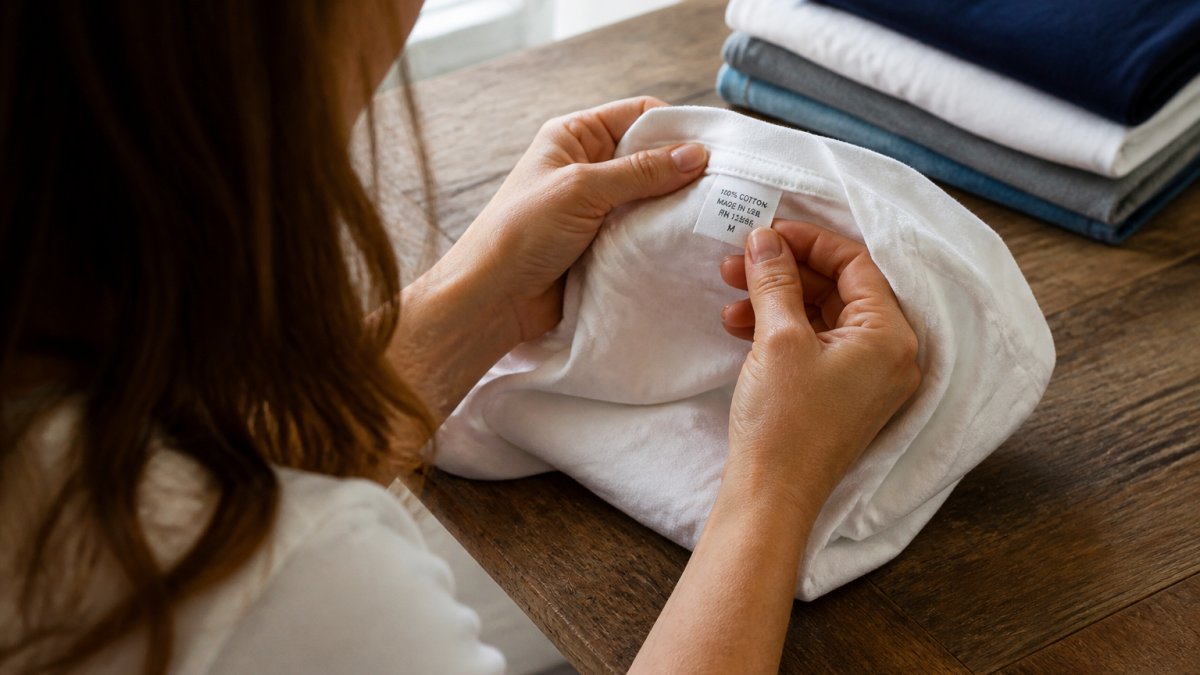
Here is what to scan for:
- Country of origin: "Made in USA" is a claim. "Imported" or a foreign country is a giveaway.
- RN number: A registration number issued to the manufacturer.
- Fiber content: 100% cotton reads differently than a blend.
- Care instructions: Real makers give clear washing guidance.
A common mistake is trusting the front of the tag only. For a deeper guide to the best quality graphic t-shirt brands, see our full breakdown. Flip it over. The back often tells a different story.
'Made in USA' vs 'Assembled in USA': The Difference That Matters
"Assembled in USA" is the escape hatch. It means the item was put together here, but the parts came from somewhere else. That is not the same as made here.
The FTC allows "Assembled in USA" only if the product's main parts are U.S.-made and assembly happens here. But many brands use it loosely.
Watch for these softer phrases:
- "Designed in USA"
- "Printed in USA"
- "Assembled in USA"
None of these guarantee domestic production. They are legal, but they are weaker claims.
The RN Number Lookup Tutorial Every Shopper Needs
An RN number is a manufacturer registration number issued by the Federal Trade Commission. It identifies the company that put its name on the label, and it is one of the few pieces of label data you can independently verify. Most guides stop at "look for the RN", this is the actual lookup process.
Step 1: Find the RN on the garment
The RN appears on the inside care label, usually near the fiber content and country of origin. It is printed as "RN" followed by a number, typically five to six digits. Some labels use the older "WPL" prefix for wool products; treat it the same way.
Watch out: an RN number is sometimes printed on a hang tag only, not the permanent care label. If the number appears on a removable tag but not the sewn-in label, that is a pattern worth questioning.
Step 2: Open the FTC's RN registry
The FTC maintains a public RN database at the agency's website. The registry is a searchable list of registered manufacturers and importers. You do not need an account, and there is no fee to search.
Chased By Grace Christian T-Shirt – Inspirational Faith Apparel →
Step 3: Search the exact number
Enter the digits exactly as printed, without the "RN" prefix. The registry returns the registered company name and, in many cases, the business address on file. Write down the company name that comes back.
Step 4: Compare the registry result to the label
The company name on the registry should match the brand or manufacturer named on the garment. A mismatch is not automatically fraud, brands contract with registered manufacturers, and the RN may belong to the factory rather than the label, but it is a question to ask the seller.
Step 5: Cross-check the company's own disclosures
Take the registered company name and look for it on the brand's sourcing or "about" page. A brand that names its manufacturer openly is easier to trust than one that hides the relationship.
What the RN number does and does not prove
The RN proves a company is registered with the FTC. It does not prove the garment was made domestically. A registered manufacturer can sew shirts from imported fabric, and an importer can hold an RN. Use the number as one clue in a larger case, not as a stand-alone certificate of American production.
A common pattern among counterfeiters is to copy a real RN from a genuine garment onto a fake label. If the registry returns a company that has nothing to do with the brand you are holding, that is a serious red flag.
How to Identify Authentic Made in USA Clothing Online
Online shopping hides the label, so you have to audit the seller rather than the shirt. You can learn more about us and the family behind our screen printing business. The most useful frame is supply-chain transparency tiers: the depth of a brand's domestic production shows up in how much of its supply chain it is willing to name.
The three transparency tiers
Tier 1, Vertical manufacturing. The brand owns or directly contracts the mill, the cut-and-sew floor, and the finishing. It can name the mill that wove the fabric and the factory that sewed the garment.
Tier 2, Cut and sew. The brand buys domestic fabric from a named mill but contracts the cutting and sewing to a separate domestic factory.
Tier 3, Assembly only. The brand imports fabric or cut pieces and assembles them here. This is where "Assembled in USA" claims live, and it is the tier most likely to be dressed up as "Made in USA."
How to audit a seller before you buy
- Ask for inside-label photos. Request a clear photo of the sewn-in care label showing country of origin, fiber content, and RN number. A real seller sends this without hesitation.
- Ask which tier they operate in. A straightforward answer, "we buy fabric from a mill in the Carolinas and sew in our own shop", is a good sign. Vague answers about "American values" are not.
- Check the sourcing page for named partners. Tier 1 and Tier 2 brands usually name at least one mill or factory. Tier 3 brands tend to describe process without naming anyone.
- Compare price to materials. Domestic cut-and-sew labor costs more than imported assembly. A very low price paired with a bold domestic claim is a warning, not a bargain.
- Look for the FTC's own guidance language. Brands that understand the standard tend to use precise phrases like "all or virtually all" or "Assembled in USA" correctly rather than slapping a flag on the listing.
Red flags of counterfeit or misleading labels
- No country of origin anywhere on the label
- A flag graphic with no text claim
- Vague "USA-inspired" or "American-owned" wording
- No RN number on the sewn-in label
- A seller who dodges requests for tag photos
How to Verify a Made in USA Claim Step by Step
Use this process on any garment before you trust the label.
| Step | What to Do | What It Proves |
|---|---|---|
| 1 | Read the inside care label | Country of origin |
| 2 | Find the RN number | Manufacturer is registered |
| 3 | Ask the seller for tag photos | Claim is visible, not hidden |
| 4 | Check the brand's sourcing page | Supply chain transparency |
| 5 | Compare price to materials | Cheap price, bold claim is a warning |
Supply chain transparency tiers help here. Top-tier brands name their mills. Mid-tier brands name the country. Low-tier brands say nothing.
If you want a deeper walkthrough, see how to find ethically produced graphic tees.
Made in USA Clothing Brands List: Where to Start
Build your shortlist from brands that show their work. A good made in USA clothing brands list includes makers who publish sourcing details.
The Chased By Grace Christian T-Shirt is a faith-based design printed in the USA, with a tear-away label and a double-needle collar.

When you compare brands, ask:
- Does the label name the country of origin?
- Is there an RN number?
- Does the brand explain where fabric comes from?
Brands that answer all three earn your trust. For a wider starting point, browse our guide to patriotic clothing brands.
Frequently Asked Questions
What does 'Made in USA' mean on a clothing label?
Under FTC rules, a Made in USA claim means all or virtually all of the product was made in the United States. That covers manufacturing, assembly, and the significant inputs like fabric and thread. Minor foreign components can still exist, but they must be negligible. A shirt cut and sewn overseas and only printed here does not qualify for an unqualified Made in USA label.
Can clothing made in the USA use imported fabric?
Yes, but only if the imported material is a negligible part of the finished product. If the fabric is a significant input, the brand should use a qualified claim like 'Made in USA of imported fabric' or 'Assembled in USA.' When you verify a Made in USA claim, ask the brand where the fabric was milled and cut. A straight answer is a good sign.
How do I check whether clothing is made in the USA when shopping online?
Start with the product page: look for a stated country of origin, an RN number, and specific language about fabric sourcing and where the garment was cut and sewn. Then run the RN number through the FTC's RN database to confirm the company is registered. If a listing only says 'designed in USA' or shows a flag graphic with no verifiable details, treat the made in USA clothing claim as unproven.
What is the 3-3-3 rule for clothes?
The 3-3-3 rule is a personal wardrobe guideline, not a legal standard: buy three items you will wear for three seasons and keep for three years. It is a useful filter when you shop for made in USA clothing because domestic garments often cost more up front, and choosing pieces you will wear repeatedly makes the higher price easier to justify. It has no connection to FTC labeling rules.
The labels are on every shirt you pick up. The question is whether you know how to read them. At Greatuncledad, we print our designs here and stand behind the quality, with a quality guarantee, fast shipping, and 24/7 email support. Sign up and find a shirt you can trust.

